Workforce
Workforce is the Reports area about the customs acts themselves: how many stamps were given, at which stations, by how many officers, and how quickly each stamp followed the previous one.
It names individual officers, so it is readable only by roles that hold the workforce permission.
Before you start
- You need a role that reads the workforce area (Secretariat admin or Organisation admin). A Customs officer does not see this tab. See What each role can do.
- The officer names and IDs come from the stamps the customs systems send. ITS does not check them against a staff list.
Open it
- Select Reports, then the Workforce tab.
- Check the Period and the sentence You are reading ….
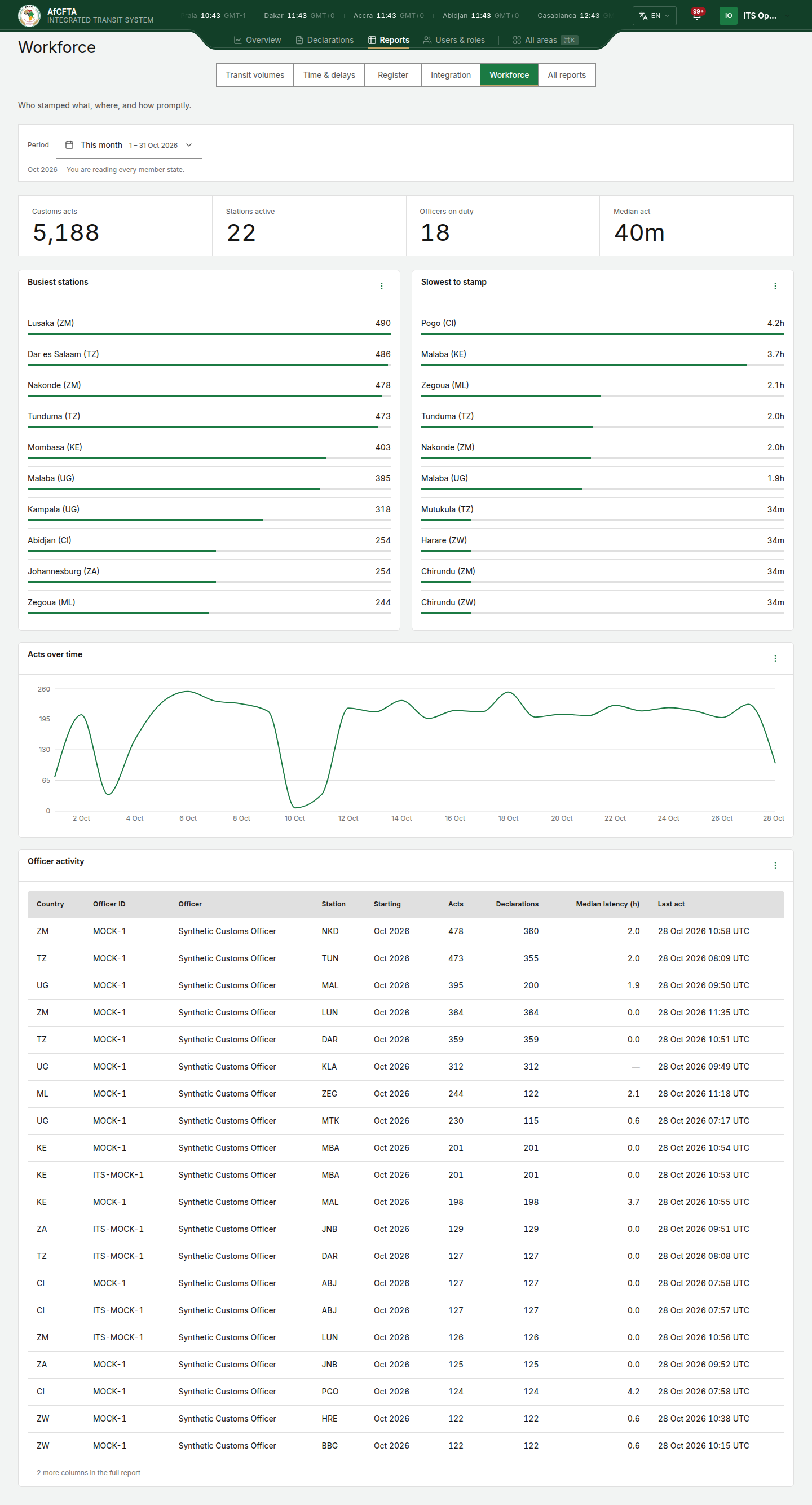
On the page
| On the page | What it is for |
|---|---|
| Customs acts | Stamps given in the period: departure, transit, entry, release and discharge. |
| Stations active | Customs offices that gave at least one stamp. |
| Officers on duty | Distinct officers who gave at least one stamp anywhere in your scope. An officer who stamped at two posts is counted once. It is given for a single day, week, month or year; for a longer span it reads — with Not available across several periods. Choose a single day, week, month or year. For a period ITS has not finished counting it reads — with Not counted yet. This period's figures are still being recounted; check again later. |
| Median act | The typical time from one stamp to the next. |
| Busiest stations | Stations with most stamps, each named with its country: Malaba (KE) and Malaba (UG) are the two sides of one border post. |
| Slowest to stamp | Stations with the longest median time before their stamp. |
| Acts over time | Stamps through the period. |
| Officer activity | One row per officer and station for the period you chose, read at that period's own size: a week as that week, a month as that month. Columns: Country, Officer ID, Officer, Station, Starting (when the period starts: a day or a week as its first day, "1 Sep", a month as "Sep 2026", a year as "2026"), Acts, Declarations, Median latency (h) and Last act. The officer's name comes from the stamp, the same name the declaration and the Stamp register show. The tile leaves Period and First act to the full report, and the line under the table says 2 more columns in the full report. View as table and Open full report show all eleven. |
What you see depends on who you are
| Secretariat | State Party (Uganda) | REC (AMU) | |
|---|---|---|---|
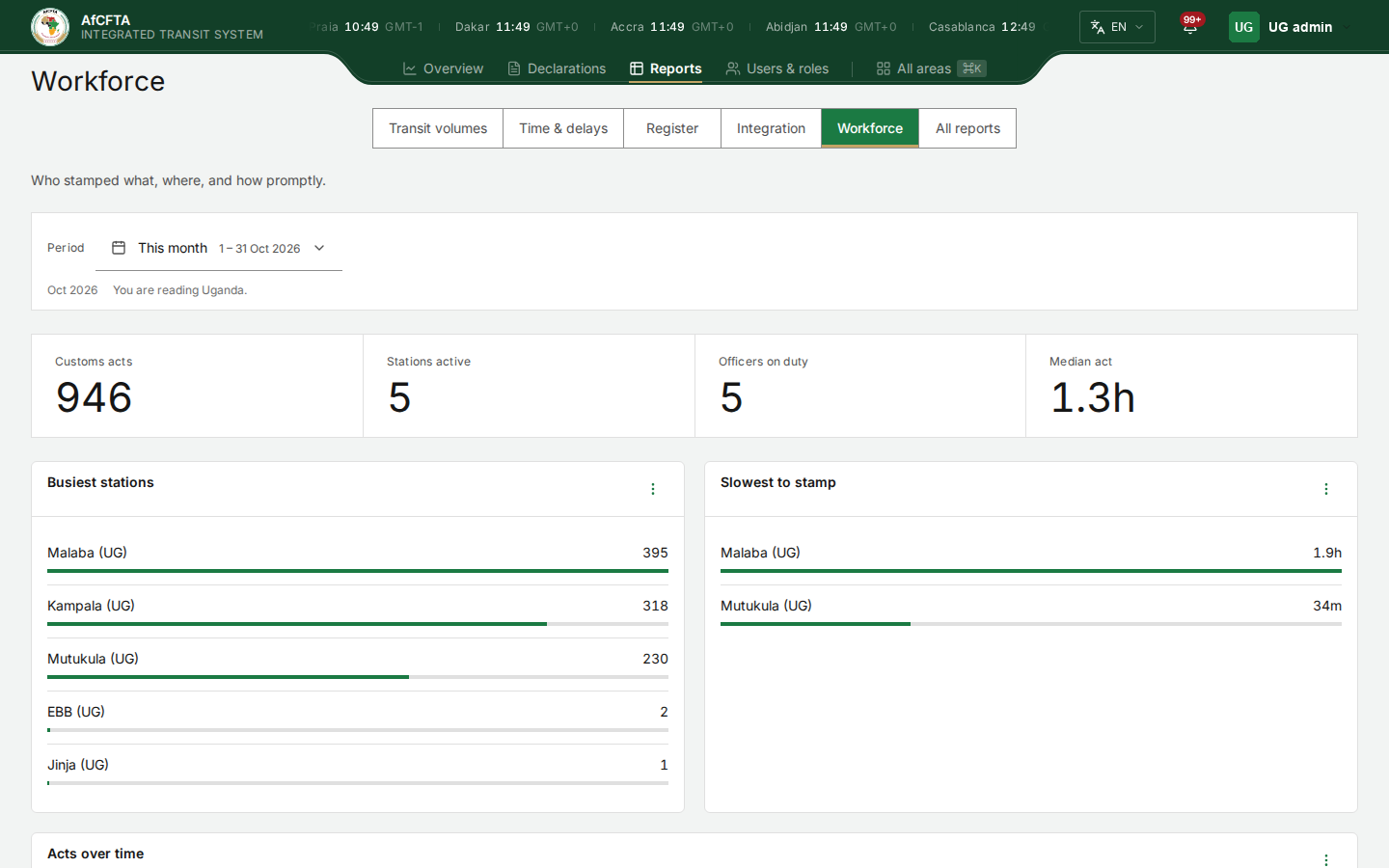
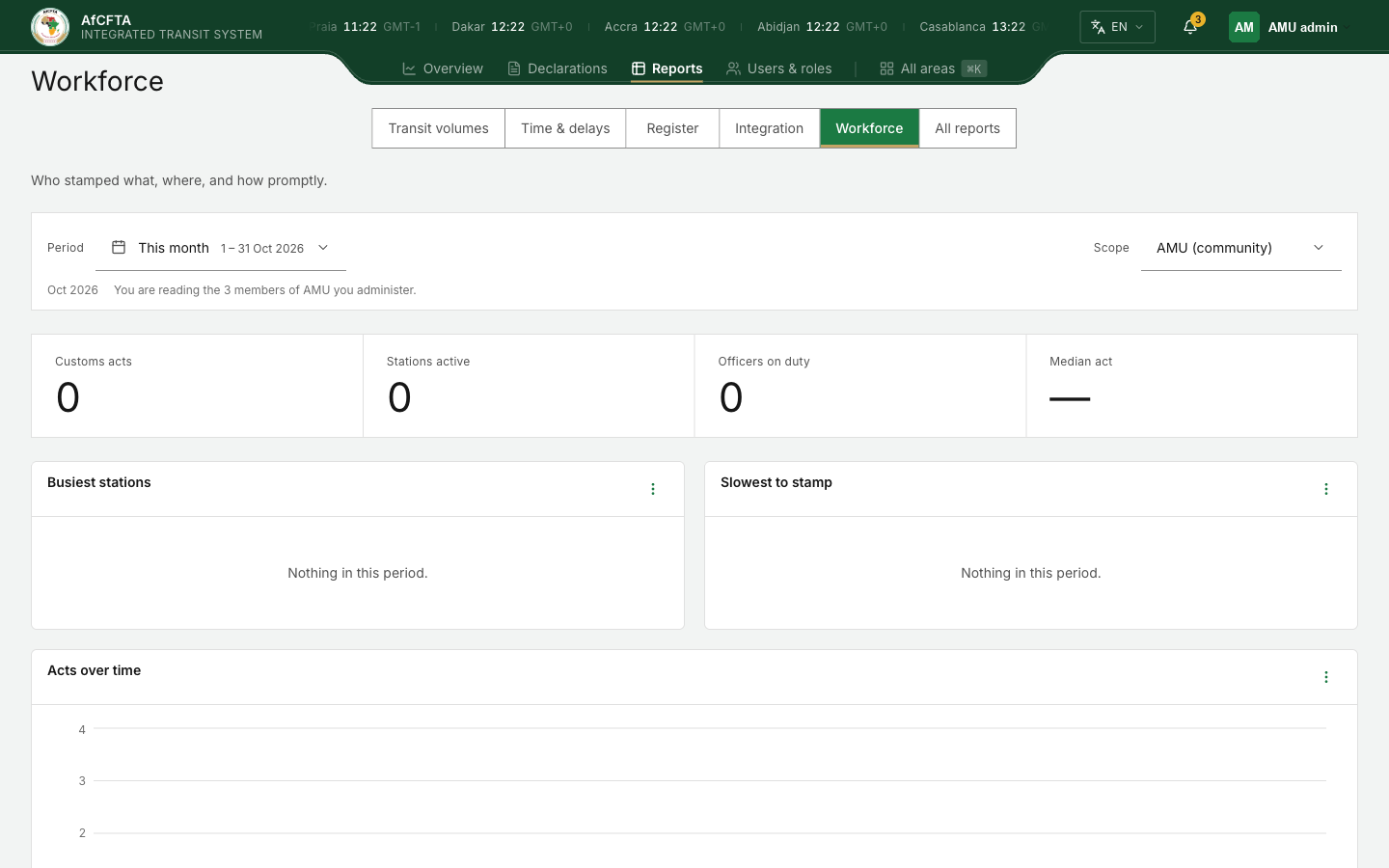
| Stations and officers | Every station in Africa | Uganda's stations and officers, such as Malaba (UG), Mutukula (UG) and Katuna (UG) | The members' stations and officers |
A State Party sees the names of its own officers only. A REC sees the officers of the members it administers.
| Secretariat | State Party | REC |
|---|---|---|
|  |  |
Find where stamping is slow
- Read Slowest to stamp. The top station takes the longest to give its stamp once a consignment reaches it.
- Compare with Busiest stations: a slow station that handles little traffic matters less than a slow busy one.
- Open Station activity or Station activity by period from All reports to see how many officers worked at each station and their median time.
- Open Officer activity (Restricted) to see the same by officer, with each officer's First act as well as the Last act. Its Period column says whether a row is a day, a week, a month or a year.
Officers are counted by the ID on the stamp
ITS counts the officer IDs the customs systems send. The pictures in this
manual come from a test system, where most stamps are made by test officers
with IDs such as MOCK-1.
Related pages
- Reports
- All reports: Officer activity, Station activity.
- Customs offices: the stations themselves.