Time & delays
Time & delays answers "where does cargo wait, and who takes longest to release it". It measures the time between stamps: from one country's transit stamp to the next country's entry stamp (the border), and from entry to transit inside a country (the dwell).
Before you start
- You need a role that reads the analytics area (Secretariat admin, Organisation admin or Customs officer). See What each role can do.
- Times are only measured once both stamps exist. A period with no finished crossings has nothing to measure, however many declarations it has.
Open it
- Select Reports, then the Time & delays tab.
- Check the Period and the sentence You are reading ….
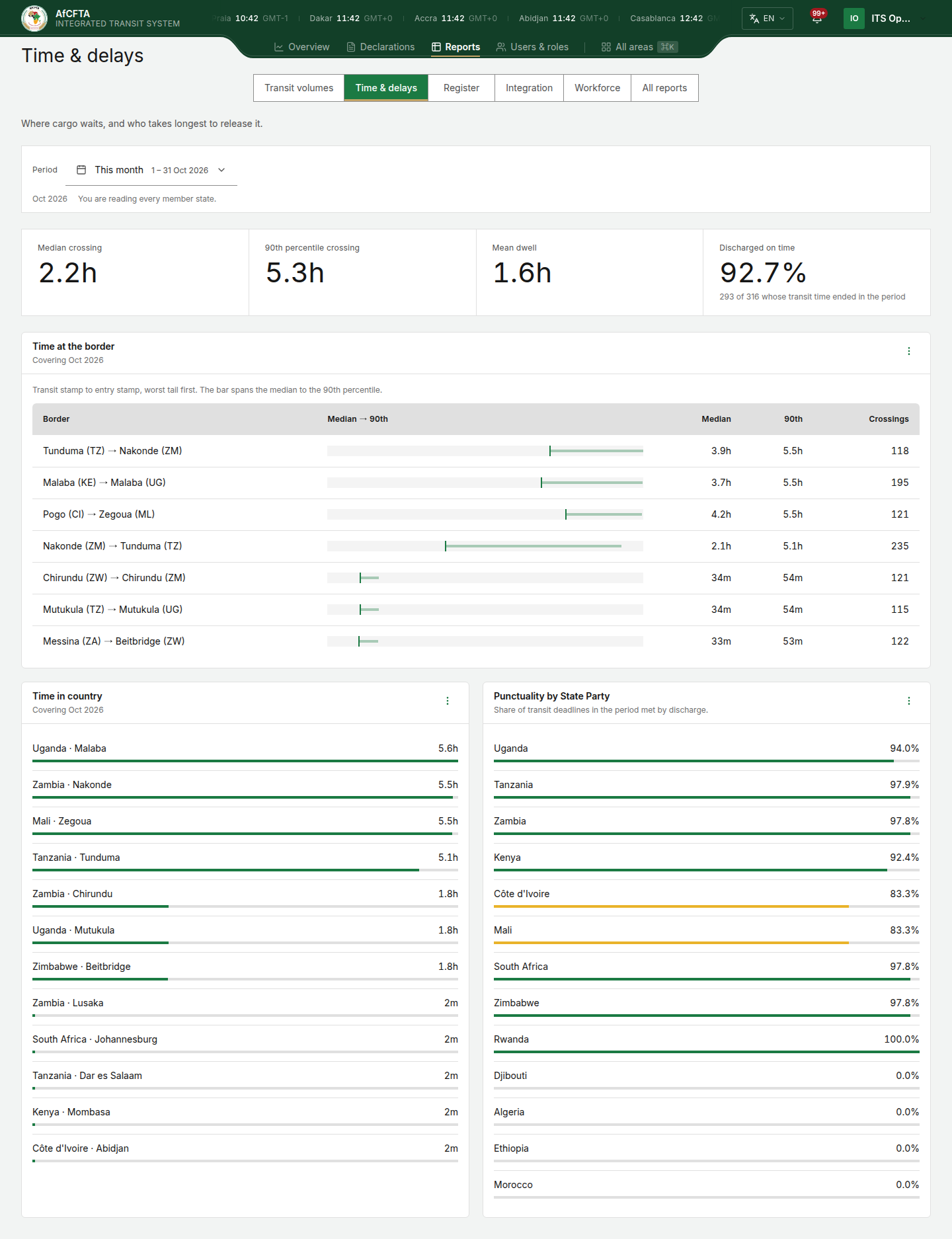
On the page
| On the page | What it is for |
|---|---|
| Median crossing | Half of all border crossings in the period took less than this, half took more. |
| 90th percentile crossing | Nine crossings in ten took less than this. It shows how bad the slow tail is. |
| Mean dwell | The average time a declaration spent inside a country between its entry and transit stamps. |
| Discharged on time | Of the declarations whose transit time ended in the period, the share discharged in time. The line under it says how many, for example "4 of 5 whose transit time ended in the period". See Discharged on time. |
| Time at the border | One row per directed border, slowest tail first. See Time at the border. |
| Time in country | How long cargo waits inside a country, one bar per country and entry post: Uganda · Malaba and Uganda · Mutukula are two bars. |
| Punctuality by State Party | For each country, the share of its transit deadlines in the period met by discharge. |
Time at the border
| Column | What it holds |
|---|---|
| Border | The transit post and the entry post, each by its name in the customs office register and its country: Malaba (KE) → Malaba (UG) is Malaba, Kenya, to Malaba, Uganda. The direction matters; each direction is its own row. A post the register does not hold is written as its country code and station code (UG KAT). Look a code up on Customs offices. |
| Median → 90th | A bar from the median to the 90th percentile. A long bar means crossing times vary a lot. |
| Median, 90th | The two times, in hours (3.9h) or minutes (40m). |
| Crossings | How many crossings the times are measured over. A border with 2 crossings says little. |
What counts as a crossing
A crossing is one country's transit stamp and the entry stamp of the country that transit stamp named as next. It is timed between the two stamps, whichever reached ITS first: at a one-stop border post the entry can be recorded before the transit.
When the country named as next never stamps, for example because it is not connected to ITS, there is no crossing to time. The declaration is left out of Median crossing, 90th percentile crossing and Time at the border; it still counts in Transit volumes.
Discharged on time
Each declaration states the day its transit time ends. Discharged on time and Punctuality by State Party count a declaration in the period that holds that day, not in the period it was lodged or discharged:
- A deadline counts only once that day, plus any grace the Secretariat has set, has passed, in UTC. A deadline later this month is not counted yet, so the current month fills in as its days go by.
- A deadline counts as met when the declaration was discharged by the end of that day, or within the grace.
- A declaration that is overdue and still open counts as missed, so an overdue transit lowers the share.
- Cancelled declarations are left out.
The grace is a number of days the Secretariat can set. It is explained in When a transit counts as overdue.
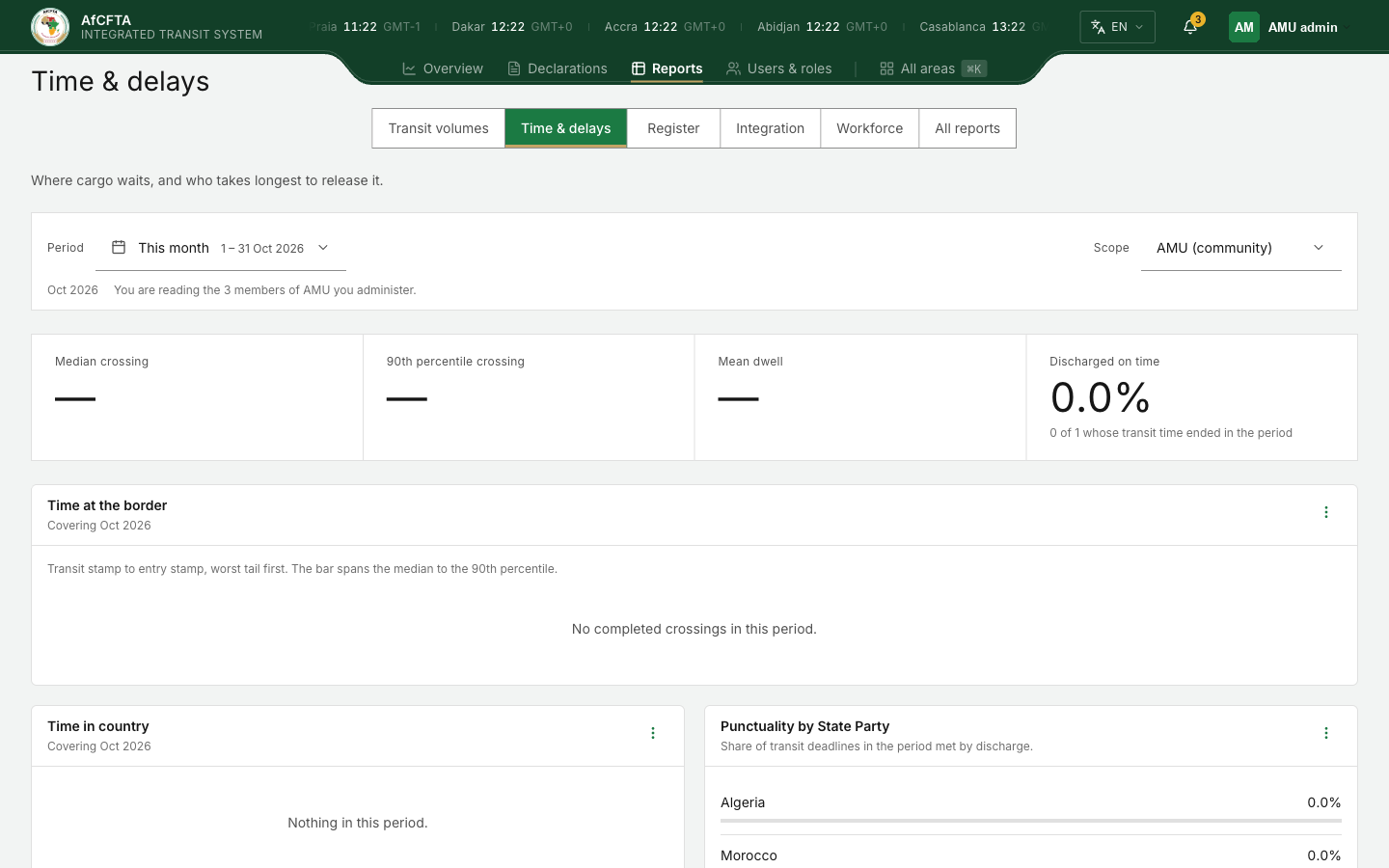
When no transit time ended in the period, the figure reads — with No transit time ended in the period, and Punctuality by State Party says No transit time ended in the period.
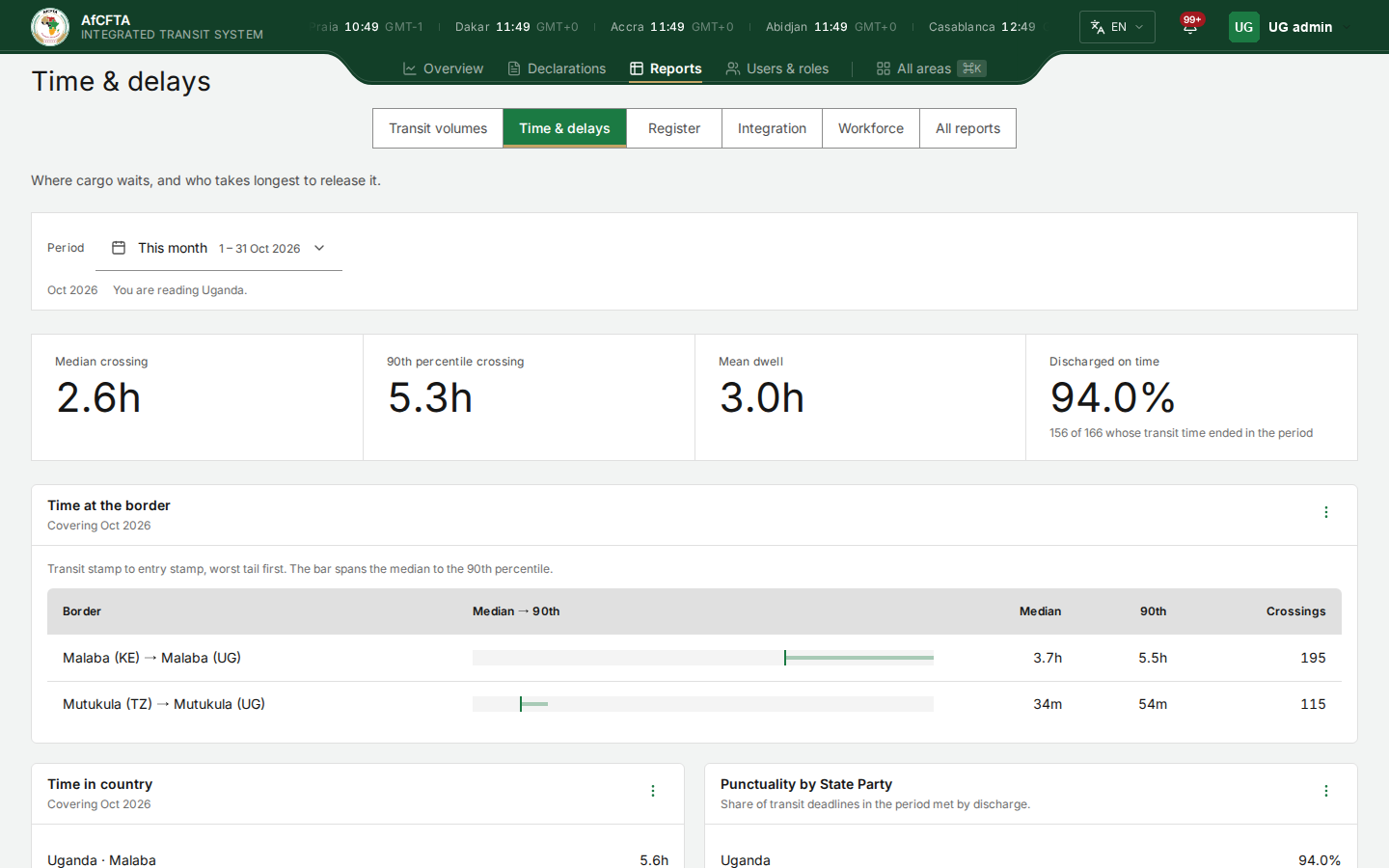
| Secretariat | State Party (Uganda) | REC (AMU) | |
|---|---|---|---|
| Borders listed | Every border crossed in Africa | Borders your declarations crossed | Borders your members' declarations crossed |
| Countries in Time in country and Punctuality | Every country | Your country, one bar per entry post | Your members |
| Scope picker | No | No | Yes |
A reader whose declarations have not crossed a border yet sees No completed crossings in this period., and — for the crossing times above it.
| Secretariat | State Party | REC |
|---|---|---|
|  |  |
Read the figures
- Read Median crossing and 90th percentile crossing together. A median of 2.5h with a 90th percentile of 5.2h means most crossings are quick but one in ten takes more than twice as long.
- In Time at the border, the first rows are the borders with the worst tail. Check Crossings before drawing conclusions from one row.
- Use View as table on Time in country or Punctuality by State Party to see every country and post, not only those that fit in the tile. Time in country keeps one bar per entry post on purpose: a 90th percentile cannot be combined across posts.
- For the full list, open Time at the border in All reports. The full report gives each side in columns of its own, From and Transit post, To and Entry post, with the post as its station code.
The border and country tiles are stored per month. With a week or a day selected they still read the month around it, as their "Covering …" line says.
Related pages
- Reports
- Register: what is overdue now, and when a transit counts as overdue.
- All reports: Time at the border, Time in country, Movements involving each State Party.